

Configuration
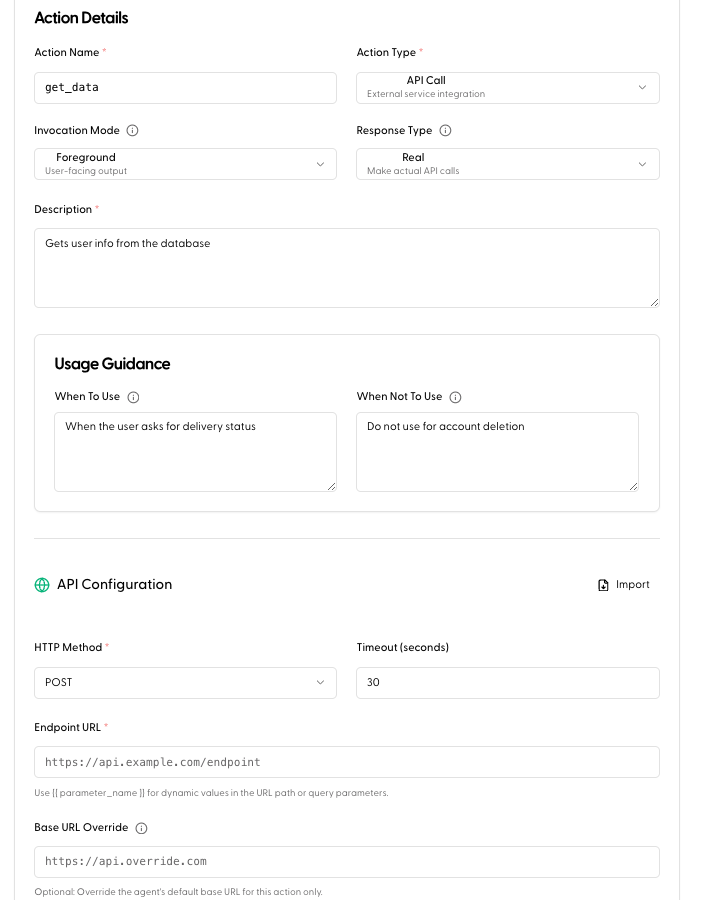
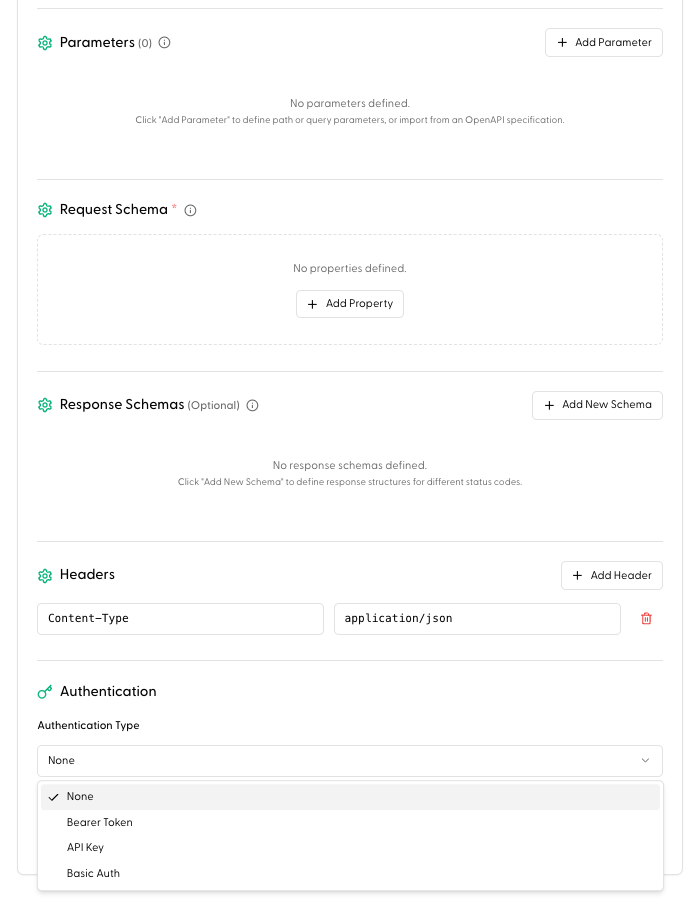
- Endpoint & Schema: Define the HTTP method, URL, timeout, and a JSON schema for the action’s parameters, including which are required. Use
{{parameter_name}}placeholders for dynamic values in the URL path or query. - Importing Specs: Bootstrap quickly by uploading an OpenAPI spec: create a single action or a full set of API Actions in bulk.
- Usage Guidance: When to use / When not to use hints that feed routing and orchestration decisions. Specific guidance here directly improves capability selection.
- Authentication: Store API keys and headers in Maitai, or reference per-request secrets (below).
- Response Handling: Make Real API calls or return Mock responses for testing and prototyping.
Invocation Mode
Every action is either Foreground or Background. What that means in practice depends on the agent’s execution mode:
Example: a background
get_loan_options action gathers data silently, which a “Loan Advisor” sub-agent then uses to formulate a tailored recommendation.
Webhook Creation actions are always foreground, they pause execution and need to drive the session, so they can’t run as background enrichment.
Per-request secrets
Instead of storing credentials in Maitai, you can reference them by name and supply the value at request time. In the action’s auth or headers config, use a{{secrets.NAME}} placeholder:
400 lists any missing names), resolved only inside auth/headers, never exposed to the LLM, and redacted before any request record is persisted. Sub-agents invoked during the run can resolve the same secrets. Full details: Agent Call, per-request secrets.
Per-request control (SDK)
Beyond secrets, the SDK can adjust how a published agent uses its API Actions for a single request, without changing the agent definition:- Capability mask: subtractively disable an action (or a whole sub-agent) for one request via
agent.disable_action("name"). You can only disable capabilities the published version exposes, never enable disabled ones. - Config overlay: toggle flow steps via
agent.config.system_steps.<step>.